
"...Regrettably, since 1991, I have repeatedly seen this kind
of character attack on women and men who complain of harassment and discrimination in the workplace. In efforts to assail their accusers' credibility, detractors routinely diminish people's professional contributions. Often the accused is a supervisor, in a position to describe the complaining employee's work as "mediocre" or the employee as incompetent...
ANITA HILL, October 2, 2007
EVIDENCE OF THE TOXIC AND RACIALLY INSENSITIVE ENVIRONMENT IN THE CORNELL UNIVERSITY THEATRE DEPARTMENT (1990-1995)
From approximately 1990 to1995, Mr. Grant conveyed the complaints of African American employees to Bruce Levitt and David Feldshuh. After bringing these highly sensitive issues to his Chairmen (Levitt/Bathrick) and the Artistic Director (Feldsuhuh), Mr. Grant was always told that investigations would take place. It soon became evident to Mr. Grant that these probes never included any communication with the African American victims.
In his report to the Senior Faculty during his departmental tenure appeal, Mr. Grant wrote an impassioned account of the hostile environment, unequal treatment, and instances of racism that he and others experienced at the Cornell University Department of Theatre, Film, and Dance. To his amazement and continued frustration, Mr. Grant was never asked to meet with a Senior Faculty member or Departmental Committee to discuss his charges.
Below are the numerous incidents that prompted Grant to file a complaint and appeal to the Cornell University's Affirmative Action Office for support:

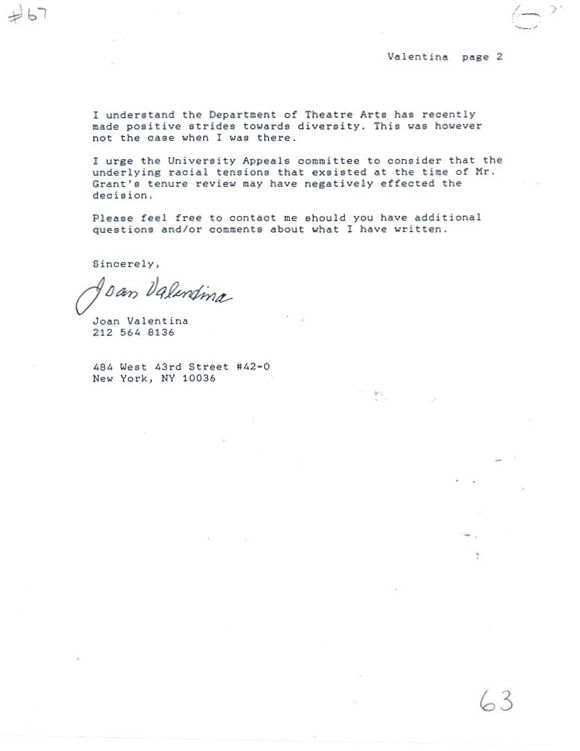


The on-campus committee that investigated Professor Grant's racial discrimination allegations wrote the following statements about the toxic working environment in the Cornell University Theatre Department:


In the deposition for Mr. Grant's legal case against Cornell University, David Bathrick (the then Chairman of the Theatre Department) admitted that when he investigated Mr. Grant's racism and unequal treatment charges, he did not speak with him or with any of the other African American victims. When asked about the Theatre Department's investigation into Mr. Grant's and other African American employee's complaints, Mr. Bathrick said:

Bathrick: ...The faculty and I want to take as thorough an examination as possible of all these charges within the time constraints.
Berg (Grant's Attorney): Okay.
Mr. Roth (The Cornell Attorney): To correct that, you said examination and it actually was an investigation.
Bathrick: Okay, Okay.
Berg: Was a formal investigation done?
Roth: Object to the form of the question.
Berg: Did the department do an investigation that resulted in a written opinion?
Bathrick: No.
Berg: Do you know –
Roth: You mean other than what's written here?
Berg: Correct. Did the department issue – okay. Do you know if the department interviewed students who had made complaints of racism in the theatre arts department?
Bathrick: I don't know.
Berg: Did you personally – were you personally involved in this investigation?
Bathrick: I was.
Berg: Do you recall what you did as part of this investigation?
Bathrick: I looked into the allegations that were made as much – well, I and my faculty looked into the allegations that were made as much as we could within the time constraints, and found that to our best knowledge they – there was no basis for it.
Berg: Do you recall who the senior faculty talked with in doing this investigation?
Bathrick: No.
Berg: Do you know if the senior faculty discussed this with Mr. Grant?
Roth: Discussed what with Mr. Grant?
Berg: His allegations of racism.
Bathrick: Well, the allegations of racism came in the letter form from Mr. Grant.
Berg: Okay.
Bathrick: And at that point, no, I mean, he wasn't there, and we didn't talk to him, but we felt there was enough feedback to understand what Mr. Grant felt, it's all in the appeal. He spelled out, you know, exactly what the reasons were, and we within – within our capabilities, we looked into them.
Berg: Do you know if anyone in the senior faculty discussed this with Chiffoney Cobb? ( A former African American employee who submitted a letter questioning the manner in which she was dismissed )
Bathrick: I don't recall.
Roth: I'm going to object to the form of the question. Discussed what with her?
Berg: Discussed the issue of racism in the theatre arts department.
Roth: As a direct opposition of –
Berg: Yes.
Roth: ––as an element of it?
Berg: Did they contact with her and discuss it, Dr. Bathrick just said no.
Bathrick: I said I don't know – I don't recall. I didn't say that they didn't, but I have no recollection of it.
Document – Deposition
CONCLUSION
Mr. Bathrick never spoke with Mr. Grant, Ms. Cobb, or the other African American complainants. Mr. Grant and the other African American employees communicated regularly during this period and for years afterwards. No one from The University or the Theatre Department has ever discussed these allegations with the African American victims in an official or formal manner.